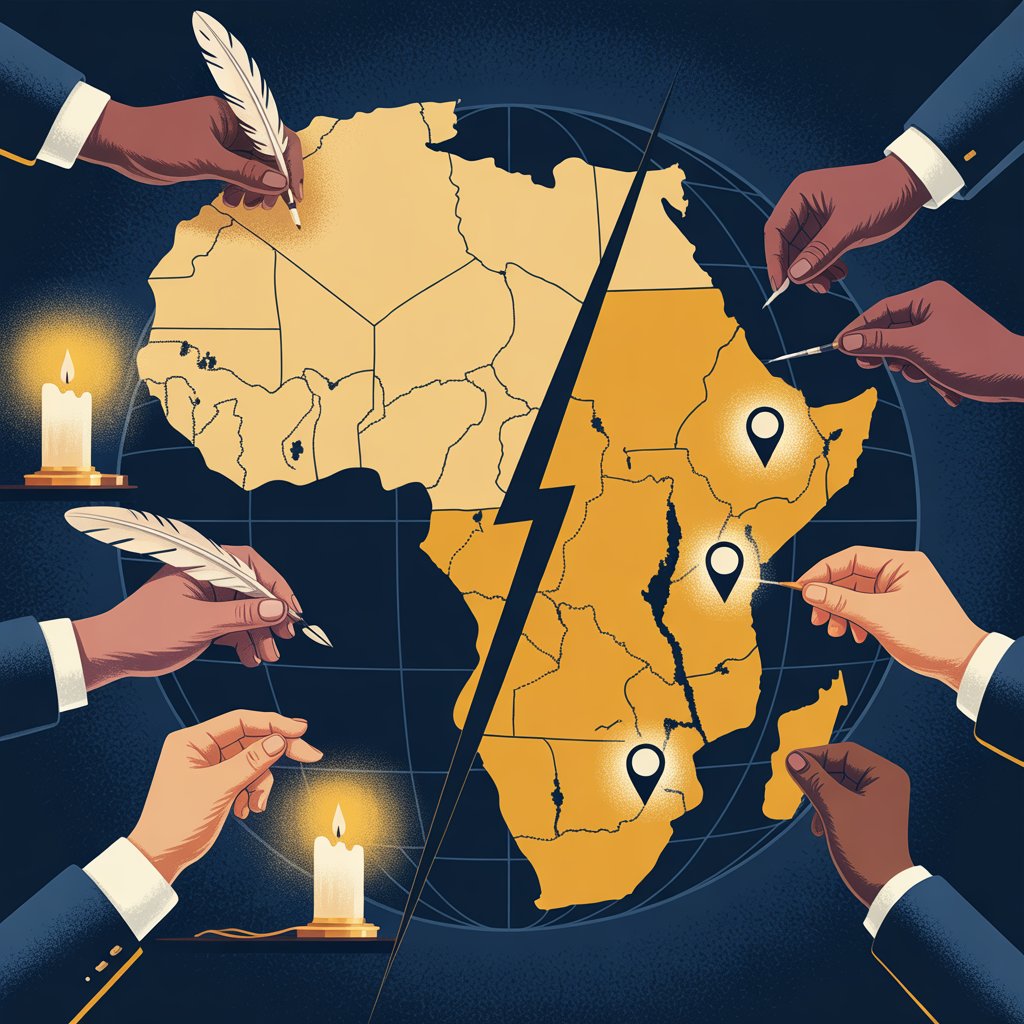
In the winter of 1884, fourteen European nations gathered in Berlin for a conference that would reshape the world. No African leader was invited. Over the course of a few months, the continent was carved into territories, borders drawn through kingdoms, languages, and bloodlines- not by the people who lived there, but by the people who understood that living on the land wasn’t enough and that controlling the administrative layer of the land meant owning the future.
They called it the Scramble for Africa.
Most people think it’s over.
It isn’t. It just moved online.
The Pattern
What made the Berlin Conference so devastating wasn’t the violence that followed, though there was plenty of it. It was the speed. By the time most Africans understood what had happened, the borders were already drawn, the claims already filed, the ownership already established.
The people who moved first didn’t necessarily have superior intelligence or superior culture. They had superior awareness of what was coming and the will to act before anyone else recognized the game.
That pattern has repeated throughout history. It repeated with the printing press. With the railroads. With the internet itself. With Bitcoin. With domain names. Each time, a new interface emerges and there’s a window. Early movers claim territory before consensus forms around the new territory. The window closes. Everyone else pays rent.
In most of those windows, the diaspora was present but not positioned, aware of the opportunity but without the framework to act on it.
We are inside one of those windows right now.
The Mirror
In 2024, a company called EarthMeta launched a platform that divides the entire digital world into programmable cities – virtual territories mapped to real-world locations, each one divisible into parcels, each parcel ownable as an NFT.
Accra. Lagos. Kingston. Dakar. Cities with deep diaspora significance, sitting largely unclaimed while the people with the most historical reason to own digital territory aren’t even aware the auction is happening.
Meanwhile, artificial intelligence agents are being given crypto wallets. They can now hold assets, execute transactions, collect revenue, and pay for services with very little human intervention.
Coinbase’s AgentKit already allows AI agents to hold wallets and execute on-chain transactions autonomously.
The infrastructure for a fully functioning digital economy, complete with landlords, tenants, and governors, is being assembled in real time.
This isn’t science fiction. The territory exists. The agents and the tools exist, and keep getting better. The transactions are already happening.
The question is the same one that hung over 1884: who will own the infrastructure when the utility arrives?
The Historical Lens
My grandfather’s generation didn’t surrender the administrative layer because they were weak. They lost it through bad contracts, predatory financing, and in cases like the Kingdom of Dahomey, outright war because the game changed before the awareness did.
I’ve spent the last several years working in cybersecurity and governance, watching organizations struggle with the same problem, the people making decisions about digital infrastructure rarely understand what they’re deciding. The technical layer moves faster than the cultural awareness. And the gap between those two speeds is where wealth transfers happen.
The diaspora has more historical pattern recognition for this moment than any other group on earth. We’ve seen what happens when new layers forms on top of physical territory and gets claimed before our community understands the stakes. We’ve lived the consequences across generations.
That knowledge is the edge. The question is whether we’ll use it this time.
The Governor’s Move
Before this post ends, one concrete thing worth doing this week:
Look up the EarthMeta listings for cities that matter to you. Note what’s claimed and what isn’t. Then read the book, the framework for evaluating whether to act is in there.
The Berlin Conference lasted four months. The window for early digital territory is longer but it is closing. Awareness is the first move.
The New Scramble is already underway. Get the full framework at thenewscramble.com.
